
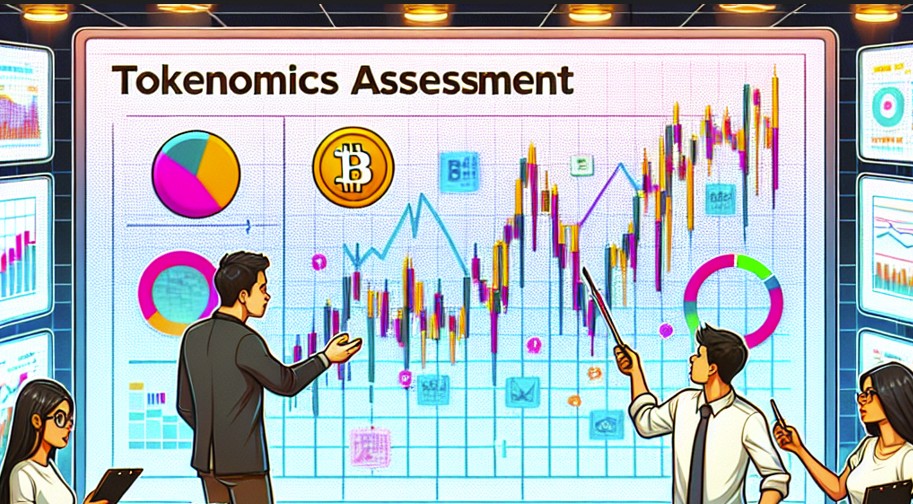
In the world of crypto, a whitepaper might outline brilliant technology, but it’s the Tokenomics—the economics of the token—that determines its long-term financial survival. Tokenomics is the framework that dictates how a crypto asset is created, distributed, governed, and ultimately gains value.
For long-term investors, assessing Tokenomics is arguably more important than analyzing mere price movements. It’s the closest thing the digital asset world has to traditional fundamental analysis.
Part 1: The Pillars of Tokenomics Assessment
Tokenomics analysis requires evaluating two primary areas: Supply and Demand/Utility.
1. Supply-Side Metrics (The Inflation/Scarcity Factor)
This focuses on the total number of tokens and how they enter the market.
- Total and Circulating Supply: The difference between the maximum number of tokens that can ever exist (Total Supply) and those currently available (Circulating Supply). A finite supply (like Bitcoin’s 21 million limit) signals scarcity and deflationary pressure.
- Vesting Schedules: This is the timeline for releasing tokens held by the founders, early investors, and the development team. Aggressive, near-term vesting schedules often signal a high risk of large sell-offs, creating supply pressure that can harm long-term holders.
- Inflation/Deflation Mechanism: Does the protocol mint new tokens (inflationary) or burn tokens (deflationary) with every transaction? Mechanisms like token burns or high staking requirements reduce the available supply, potentially increasing scarcity.
2. Demand and Utility Metrics (The Value Factor)
This focuses on what the token is used for within its ecosystem. A token with no real utility is just a speculative chip.
- Governance: Does holding the token grant voting power over the protocol’s future (e.g., decentralized autonomous organizations or DAOs)? High governance utility often drives demand.
- Staking and Rewards: Can users lock their tokens to secure the network and earn rewards? This encourages long-term holding and temporarily removes supply from circulation.
- Fee Capture/Revenue: Does the token capture value from the transactions generated by the platform (e.g., decentralized exchange fees)? Tokens that capture real-world revenue are more akin to earning assets.
Part 2: The Challenge of Manual Tokenomics Assessment
Analyzing Tokenomics is complex and vulnerable to human error:
- Complexity of Vesting: Manually tracking dozens of complex vesting schedules across different contracts is tedious and prone to miscalculation.
- Simulation Difficulty: Accurately predicting future inflation under various usage scenarios (e.g., what happens if the network doubles its users?) requires advanced mathematical modeling.
- Vast Data Integration: The analysis requires integrating data from whitepapers, GitHub development logs, on-chain transaction data, and governance proposals simultaneously.
Part 3: How AI Revolutionizes Tokenomics Assessment
Artificial Intelligence and Machine Learning (ML) are perfectly equipped to overcome these challenges, transforming Tokenomics assessment from a qualitative guess into a quantitative science.
1. Algorithmic Vesting and Supply Modeling
AI excels at complex scenario planning:
- Precision Forecasting: ML models can process all public vesting contract data to create high-precision supply forecasts. They can accurately model the market impact of every single future token unlock, giving investors a clear view of potential selling pressure.
- Dynamic Inflation Simulation: AI can simulate the token supply under different growth assumptions. For example, it can model inflation/deflation if network usage grows by 10%, 50%, or 200%, helping investors understand the long-term price floor.
2. Real-Time Utility and Demand Scoring
AI analyzes real-time network behavior to score the utility of a token:
- Governance Analysis: NLP models can scan hundreds of governance proposals and community discussions. They flag the tokens most actively used for governance, identifying true decentralized utility versus passive holding.
- Fee Capture Validation: AI constantly monitors smart contract activity to verify that the token is indeed capturing the fee revenue as promised in the whitepaper, linking the token directly to the platform’s economic output.
3. Vulnerability and Risk Identification
Some Tokenomics models have built-in flaws that AI can spot:
- “Rug Pull” Detection: ML models look for specific red flags in the initial token distribution—such as a heavily concentrated supply held by the founders or a low percentage of locked liquidity—which are key indicators of a potential scam or “rug pull.”
- Economic Attack Modeling: Advanced AI can simulate potential economic attacks (e.g., flash loan attacks or governance exploitation) that exploit flaws in the token’s incentive structure.
Conclusion: The Future of Crypto Valuation
Tokenomics assessment is the engine of long-term crypto valuation. It moves the investor away from speculative price noise and toward the underlying economic reality of a project.
By leveraging AI, investors gain the ability to model complex supply schedules, validate real utility in real-time, and identify hidden economic risks. Integrating AI into your due diligence process is the best way to ensure your crypto holdings are based on solid economic fundamentals, not just hype.