
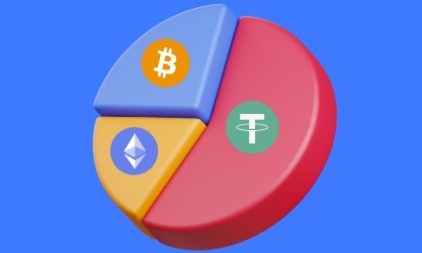
Before reading this crypto portfolio beyond Bitcoin, I suggest you to read the Bitcoin Ultimate Guide in our previous article.
Introduction: Stepping Out of Bitcoin’s Shadow
Bitcoin (BTC) is the foundation, the digital gold. However, the cryptocurrency market is vastly more expansive than just BTC. Everything that isn’t Bitcoin is generally grouped under the term Altcoin—short for “alternative coin.”
This guide takes you past the dominance of Bitcoin and into the rapidly evolving landscape of Altcoins and the revolutionary financial movement they power: Decentralized Finance (DeFi). Understanding these areas is crucial for true portfolio diversification and for engaging with the cutting edge of digital finance.
1. The Altcoin Universe: More Than Just Digital Money
Unlike Bitcoin, which primarily focuses on being a store of value and a medium of exchange, Altcoins are designed to offer specific functionalities, solving various technological or real-world problems. They can be broadly categorized as follows:
| Category | Description | Key Examples |
| Platform/Smart Contract Coins | Designed to host decentralized applications (dApps) and run smart contracts—self-executing agreements coded on the blockchain. | Ethereum (ETH), Solana (SOL), Cardano (ADA) |
| Stablecoins | Cryptocurrencies pegged to a stable asset (like the US Dollar) to minimize volatility. Essential for trading and DeFi. | Tether (USDT), USD Coin (USDC) |
| Memecoins / Utility Tokens | Coins created for community engagement or to provide specific access/utility within a platform (e.g., decentralized exchanges, gaming). | Dogecoin (DOGE), Polygon (MATIC) |
2. Ethereum: The Pioneer of Smart Contracts
Ethereum stands as the second-largest cryptocurrency and is arguably the most important Altcoin. Its innovation was the introduction of Smart Contracts.
- What are Smart Contracts? These are automatically executing computer programs stored on the blockchain. They execute when predetermined conditions are met, eliminating the need for a central authority to enforce agreements. Think of it as a digital vending machine for agreements.
- The Foundation of dApps: Ethereum’s smart contract capability allows developers to build complex applications (dApps) directly on its blockchain. Most of the early DeFi ecosystem was built here.
3. The Scalability War: Ethereum Challengers
Ethereum’s early success led to issues with network congestion and high transaction fees (“gas fees”). This paved the way for “Ethereum killers”—new blockchains designed to improve speed and reduce costs:
| Blockchain | Core Philosophy / Technology | Advantage |
| Solana (SOL) | Extremely high speed via a unique Proof-of-History (PoH) mechanism. | Very fast transactions (up to 65,000 TPS) and ultra-low fees. |
| Cardano (ADA) | A research-first approach, focusing on security and academic peer-review. | Strong emphasis on methodical, secure protocol development and low energy consumption (PoS). |
4. Decentralized Finance (DeFi): The Revolution
DeFi is the collective term for financial applications built using smart contracts on blockchains (primarily Ethereum and its competitors). It aims to recreate and enhance traditional financial services in a trustless, transparent, and permissionless way.
Core DeFi Use Cases:
- Lending & Borrowing: Protocols like Aave or Compound allow users to deposit crypto to earn interest (lenders) or borrow crypto using their assets as collateral (borrowers), all without a bank.
- Decentralized Exchanges (DEXs): Platforms like Uniswap allow users to swap tokens directly from their wallets, without a centralized intermediary. Liquidity is provided by other users (Liquidity Pools), who earn trading fees.
- Staking & Yield Farming: Users can lock up (stake) their crypto to secure a Proof-of-Stake network and earn rewards, or participate in complex strategies to maximize returns (yield farming).
5. The Major Risk: Smart Contract Vulnerabilities
While exciting, DeFi comes with significant risks. The primary concern is Smart Contract Vulnerability.
- Code is Law: Since smart contracts execute automatically, if a bug or flaw is written into the code, malicious actors can exploit it to drain funds (a hack).
- Immutability Risk: Because the code is often permanent once deployed on the blockchain, fixing a vulnerability after a hack can be challenging or require complex governance votes.
Conclusion: Moving beyond Bitcoin introduces both tremendous opportunity and high risk. Altcoins offer specialized utility, and DeFi is reshaping banking. However, the high volatility and technical complexity of these sectors demand a thorough understanding before investing.

Pingback: AI Bitcoin Prediction
Pingback: Staking, Farming, Lending: The 3 Pillars of Passive Yield in DeFi
Pingback: Real World Assets (RWA): The Next Wave of Tokenization in DeFi
Pingback: The Final Diversification Strategy: A Prudent Investor’s Guide to Resilience
Pingback: AI for Long-Term Crypto Selection: Beyond the Hype Cycle